
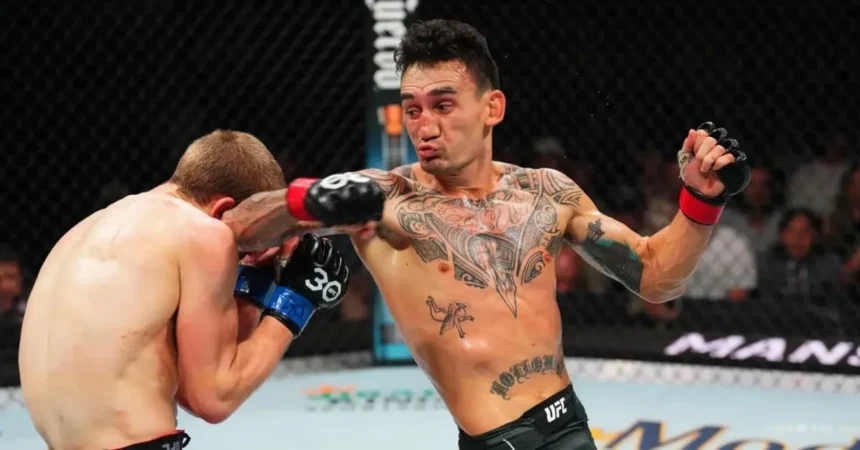
Former UFC middleweight champion Robert Whittaker has placed Max Holloway at the center of the BMF conversation, even though he still does not fully buy into the belt’s meaning. In a recent appearance on Submission Radio, Whittaker admitted he does not understand what the BMF title represents but argued that Holloway embodies the spirit of it more than anyone else.
Whittaker Backs Holloway as BMF Ahead of Oliveira Showdown
Whittaker’s comments came ahead of Holloway’s scheduled BMF title defense against Charles Oliveira at UFC 326, a rematch that has been promoted as a clash between two of the most popular and durable fighters in UFC history. The BMF belt, originally treated as a novelty in 2019 and later revived at UFC 300, has shifted from a one‑off spectacle to a recurring, albeit unofficial, symbol of high‑stakes entertainment.
Whittaker said, in an intervierw with Submission Radio, he still does not know what the BMF stands for in a structural sense, adding that he is not sure many fans or fighters truly grasp it either. Even so, he singled out Holloway’s UFC 300 win over Justin Gaethje as the moment that made the belt feel meaningful. Holloway stopped Gaethje in the final second of the fifth round, then pointed to the center of the octagon to signal that he was willing to stand and trade if the fight had gone to a decision.
“I still don’t really understand what the BMF is, what that means. I don’t think anyone does. But Max is definitely the BMF. That fifth‑round finish, the way he carries himself, the way he accepts fights at lightweight and at featherweight, that’s what makes people see him as BMF,” Whittaker said.
When asked about Holloway’s upcoming BMF rematch with Oliveira, Whittaker leaned into the Brazilian’s reputation as a submission specialist but still favored Holloway’s striking and durability. He said Oliveira is dangerous in every round and can catch opponents with a finish at any moment, but that Holloway’s volume, timing, and ability to keep fights vertical tilt the matchup in his favor. Whittaker also noted that Oliveira may have to chase the finish more than normal, which could expose him to countering combinations and body shots from Holloway.
Whittaker’s stance fits alongside a broader fan‑driven push to treat Holloway as the standard bearer for the BMF concept. Analysts and fighters have pointed to his willingness to change weight classes, accept short‑notice fights, and headline major pay‑per‑views without always competing for a traditional title as proof that he meets the informal BMF criteria. At the same time, internal UFC politics and the lack of a formal structure around the belt mean the BMF remains more of a narrative than an official division chart.
In the end, Whittaker’s take is simple: he may not understand the BMF on paper, but he sees Holloway’s style, risk‑taking, and longevity as the closest thing the UFC has to a real BMF champion. If Holloway can survive Oliveira’s submission game and push the fight into the later rounds, Whittaker’s view is that “BMF” will be reinforced by what happens in the cage, not by anything written on a belt.