
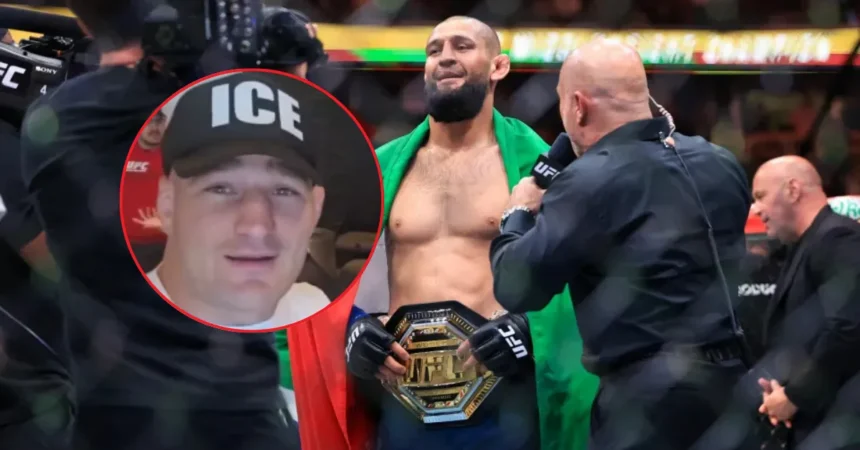
Former UFC two‑division champion Daniel Cormier has warned Khamzat Chimaev that the version of Sean Strickland who dismantled Anthony Hernandez at UFC Houston would pose a serious problem for him, and that Strickland’s recent “off” outings against Dricus du Plessis should not be taken as an indicator of his full ceiling.
How Daniel Cormier believes Sean Strickland’s UFC Houston form could shake up Khamzat Chimaev’s reign
Cormier made the comments in a video reaction to Strickland’s third‑round TKO win over Hernandez, where Strickland landed hard body shots, controlled the distance, and finished “Fluffy” with ground‑and‑pound after a knee collapsed his body.
“If that guy that showed up tonight shows up in that [Khamzat] fight, it would be a much more difficult fight for the great Khamzat Chimaev, because even Israel Adesanya at the peak of his power struggled with that version of Sean Strickland. In the Dricus Du Plessis fight, it didn’t seem like Sean was locked all the way in; he seemed a little messed up.”
Cormier explicitly tied the Houston performance to Strickland’s earlier run of form, including the 2023 win over Israel Adesanya, when he said that if that same Strickland shows up opposite Chimaev, the matchup becomes far more even on the feet.
He noted that even a prime‑form Adesanya struggled to solve Strickland’s long‑range jab, movement, and counter‑striking, implying that Chimaev would face similar issues if Strickland is fully dialed in. Cormier then contrasted that sharp version with Strickland’s two losses to Dricus du Plessis at UFC 297 and UFC 312, where Strickland appeared less focused and physically compromised, and suggested those fights do not reflect his current or best level.
The key concern for Chimaev, in Cormier’s view, is whether Strickland can defend takedowns and avoid being flattened for large stretches of the fight. Chimaev traditionally looks to pressure, close the distance, and use wrestling to smother opponents, but the Houston tape showed Strickland maintaining good head‑position, using underhooks and body‑punch countering, and surviving or stuffing Hernandez’s attempts to drag him down.
Analytics from the Hernandez bout highlight Strickland’s 76% takedown defense and his ability to keep “Fluffy” at range, which Cormier sees as a template for how he might handle a high‑level wrestler like Chimaev.
Cormier’s point is that if Strickland brings the same combination of jab pressure, body work, and defensive awareness to a fight against Chimaev, the matchup shifts from a straightforward grappling‑style mismatch into a more contested battle where Strickland can land early, damage Chimaev en route in, and force the titleholder to fight for every takedown.
He stopped short of predicting a Strickland win but framed the scenario as significantly harder for Chimaev than it would be were Strickland still in the off‑form state he displayed in the du Plessis rematches. Given that Strickland has already called out Chimaev for a title shot and UFC brass has signaled interest in keeping Khamzat at middleweight, Cormier’s comments add another layer of intrigue to what would be a stylistic clash between a pressure‑oriented wrestler and a technical pressure boxer.